Hello and welcome back! I have now finished collecting the data from the summer school phoneme project and have written up my findings. Please see a summary below.
Findings
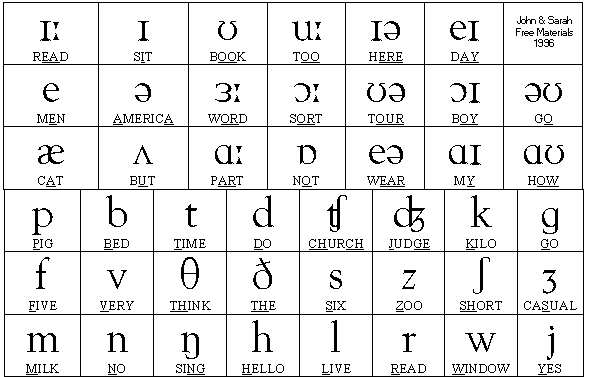
For both the initial and the final test I used the John and Sarah free materials phonetics chart found at
http://www.englishbiz.co.uk/grammar/images/phonetic_alphabet.gif
For the initial recording, I simply used the words associated with each symbol and listened for inaccuracies or mispronunciation of the vowel sound. I thought it would have confused the students too much to have introduced them to all the symbols at once, that was what the two weeks of exercises would do.
When I did the final recording however, I gave the students the full phonetic chart. By this point they had been introduced to all the sounds and symbols and could say both the sound individually and the associated word. This in itself showed improvement, but as it was different from the original task I had set, I also asked the students to repeat just the words for me, as they had done in the first recording. In the final recording however, they said both the vowel and the consonant sounds.
Problematising the research.
I am conscious of the fact that any analysis of the students reproduction of phonemes is to some extent subjective, and although I developed a detailed knowledge of phoneme sounds at drama school, they are still heard through the filter of my own voice and body and my analysis needs to take account of my own subjectivity when I hear the sounds as well as individual vocal differences in my students.
Unfortunately due to individual students’ timetable changes, not all of the original members of the class were present in the second week for the final voice recording. However, I have chosen to concentrate on two students in some detail who were present for the full two weeks. In future, I would want to conduct similar research studies over a longer period of time with a more established year long class.
Summary of findings
There was a distinct lack of awareness and recognition of long vowel sounds noticeable in Student A’s first recording, but this had been substantially improved by the end of the two weeks. As some of the tasks in the final recording were more complicated, they flagged up other areas for improvement for both students, in particular word endings and consonant sounds. In terms of the improvement in vowel sounds from the initial recording to the final one however, significant improvements could be heard both in terms of the length and quality of the sound, particularly with Student A. Although student B did make some improvements, her recordings were both more hesitant and perhaps I may have to think about conducting one to one recording sessions in future in order to minimise self consciousness and embarrassment in front of peers. It could also be that the unfamiliarity of the equipment and the environment was off putting.
Some of the consonant sounds had not been consolidated by the end of the two weeks, but as we had spent most of the time on the vowel sounds, this was understandable. With more time, the consonant sounds could be worked on in much the same way. It would also be interesting to see how well the students could use this new awareness and how applicable this new knowledge would be to them., Again, this type of study would need to be conducted over a longer period of time.
Wednesday, 24 September 2008

Subscribe to:
Posts (Atom)